
Loading…
Loading…
Andromeda is not news any more. But the way most advertisers plan creative still belongs to the system it replaced. The accounts that adapted stopped asking 'who should we target?' and started asking 'how many genuinely different reasons to buy are we giving Meta?'
Meta announced Andromeda in December 2024 and rolled it out across Facebook and Instagram through 2025. If you follow paid social closely, you have already read a dozen explainers. So why another one, almost two years after the announcement?
Because the explainers mostly covered the technology, and the technology was never the hard part. The hard part is that Andromeda quietly changed what a 'good' Meta account looks like, and very few accounts have actually been rebuilt around it. The same patterns still show up in a lot of Meta accounts: tightly stacked interest audiences, multiple ad sets competing for the same people, and creative 'testing' that amounts to the same image in four background colours.
Those habits made sense before Andromeda. Today they work against you. This guide skips the hype and focuses on the one practical consequence that matters most: your creative now does the job your audience settings used to do.
Every time someone opens Facebook or Instagram, Meta has to choose which ads to show from tens of millions of possible candidates. It does this in stages. The first stage, retrieval, narrows that enormous pool down to a few thousand ads that might be relevant. Only then do the heavier ranking models decide which ads actually win the auction.
Andromeda is Meta's new retrieval engine. According to Meta's own engineering team, it delivered a 6% improvement in retrieval recall and an 8% improvement in ad quality on selected segments when it launched. Those numbers sound modest, but retrieval is the gate. If your ad does not get through retrieval for a given person, it never reaches the auction for that person, regardless of your bid or budget.
Meta was also explicit about why it built Andromeda: it expects the number of ad creatives in its system to 'grow significantly' because of Advantage+ automation and generative AI tools. In other words, Andromeda was designed for a world where advertisers supply many more creatives and the system works out who each one is for.
Under the old model, you told Meta who to show your ads to, and your creative tried to convince whoever turned up. Under Andromeda, the relationship flips. Meta reads your creative — the message, the visuals, the format, the people in it — and uses that to decide who is likely to respond. The creative becomes the strongest targeting signal you control.
This is also why Meta has steadily pushed Advantage+ campaigns and broad audiences as the default setup. Detailed targeting has not disappeared, but it increasingly behaves as a suggestion rather than a hard boundary. If the system predicts someone outside your defined audience will respond better, it will find them. Your audience settings matter less. Your creative mix matters more.
The practical implication is uncomfortable for a lot of advertisers: if you give Meta four ads that all say the same thing in the same way, you have effectively given it one targeting signal. Small variations — a different headline, a new colour, a slightly different crop — are widely reported to be treated as near-duplicates. They do not open up new audiences. Different ideas do.
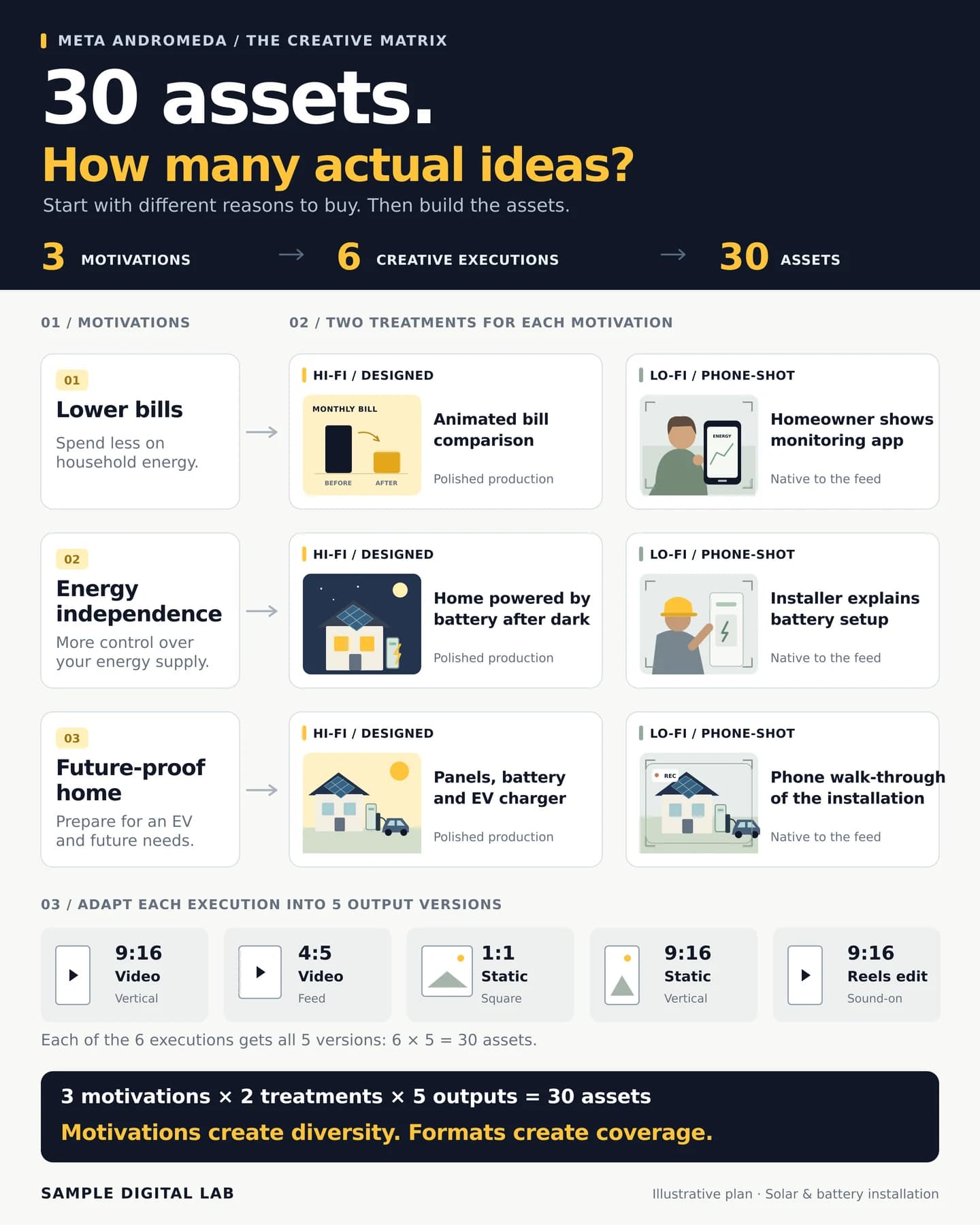
Meta's own creative guidance includes a simple template for building creative volume without losing your mind. We have adapted it into the planning framework we recommend to every paid social client. It has four layers.
Layer one: motivations. Start with three distinct reasons someone would buy from you — or three barriers that stop them, or three needs your current ads are not addressing. This is the most important step, and the one most teams skip. A motivation is not a product feature. It is a reason a real person cares.
Layer two: treatments. Produce each motivation in two visual treatments. A hi-fi version is polished: motion graphics, studio photography, designed layouts. A lo-fi version looks native to the feed: phone-shot video, a person talking to camera, a screenshot, a real customer. Different people respond to different production styles, and Andromeda treats them as different signals.
Layer three: outputs. Adapt each of those six creative executions into the five output versions Meta's placements need — vertical 9:16 and 4:5 video, 1:1 and 9:16 statics, and a sound-on 9:16 version for Reels. Six executions, five versions each: thirty assets.
Layer four: placements. Make sure every asset can run well across at least six placements. If your 9:16 story version is just a square image with black bars, the system will quietly stop showing it there, and you lose reach you have already paid to produce.
Frameworks are easier to judge with a real category in front of them, so here is how the matrix looks for a residential solar and battery installer. This is an illustrative plan, not a client result — but it is the kind of plan we would build for a business in this sector.
Concept one: lower bills. The most obvious motivation, and the one most competitors already use. The hi-fi version is a clean animated comparison of a typical monthly bill before and after installation. The lo-fi version is a homeowner holding up their phone, showing the monitoring app on a sunny afternoon and explaining in their own words what changed.
Concept two: energy independence. A different buyer entirely — someone less interested in payback periods and more worried about price swings and grid reliability. The hi-fi version shows a home running on stored battery power after dark. The lo-fi version is the installer on the roof, explaining in thirty seconds how the battery keeps the lights on.
Concept three: a future-proof home. This speaks to people planning ahead: an electric car on the horizon, a renovation, resale value. The hi-fi version is a designed render of the finished house with panels, battery and EV charger. The lo-fi version is a walk-through of a completed installation, filmed on a phone.
Notice what is not on the list: three versions of 'save money' with different stock photos. Each concept is aimed at a different person with a different reason to act, which is exactly what gives Andromeda something to work with. You could equally build the matrix around barriers — upfront cost, trust in the installer, disruption during installation — and many accounts benefit from mixing motivations and barriers.
Thirty assets sounds like a lot of production, and it is easy to conclude that more files equals more diversity. It does not. Look at the matrix again: the five formats of a single creative are the same idea in different shapes. Meta's placement asset customisation lets you upload them together as one ad, so the system serves the right shape in the right placement.
That means the matrix gives Andromeda six genuinely distinct ideas, not thirty. The motivation layer and the treatment layer create diversity. The format layer creates coverage. Both matter, but for different reasons, and confusing them leads to the most common mistake we see: teams producing thirty resized versions of one concept and wondering why performance does not move.
This is also why 'creative volume' advice can be misleading. The goal is not volume for its own sake. The goal is the number of different reasons, people and contexts you are showing the system. Thirty files built from one idea is still one idea.
Creative diversity only helps if the account structure lets the system use it. The setup that suits Andromeda is simpler than most legacy accounts.
Consolidate. Fewer campaigns and fewer ad sets, each with enough budget to exit the learning phase. Splitting the same audience across five ad sets with five ads each starves every one of them of data. One ad set with a genuinely varied creative pool gives the system room to match each idea with the people it suits.
Go broad unless you have a reason not to. Advantage+ audiences or broad targeting with minimal restrictions let the creative do the targeting. Keep hard exclusions where they matter — existing customers for acquisition campaigns, locations you do not serve, regulatory requirements — and let go of the interest stacking.
Refresh by concept, not by resize. When performance fades, the answer is rarely a new colour or a new headline on a tired idea. It is a new motivation, or an existing motivation in a treatment you have not tried. Plan creative refreshes as new rows in the matrix, not as edits to old ones.
This is the conversation we are having most often with clients, and it is worth being direct about. Many businesses still budget for Meta as if media is the investment and creative is an overhead: almost everything goes on spend, and the ads themselves are whatever can be produced quickly in-house.
Under Andromeda, that split no longer makes sense. If creative is the targeting, then a thin creative pool is a narrow targeting setup — no matter how much budget sits behind it. Spending more on media behind one idea mostly means showing that one idea to the same kind of person more often.
Meta itself has published figures pointing in the same direction: it reported that advertisers who adopted Advantage+ creative alongside its AI-driven targeting saw a 22% increase in return on ad spend. Treat any platform's numbers about its own products with healthy scepticism, but the direction is consistent with what the system is built to reward.
The practical shift is to plan creative production as part of the media plan. Before deciding how much to spend, decide how many distinct ideas the budget needs to feed — and make sure there is time and money to produce them properly, in both treatments, in every format.
The final change is in reporting. In a matrix account, the useful question is not 'which ad won?' but 'which motivation and which treatment are working, and for whom?' Individual ads come and go. Motivations are what you learn from.
Name every ad so you can roll results up by concept and treatment — for example, C1-BILLS_HIFI and C2-INDEPENDENCE_LOFI. After a few weeks, compare spend share, cost per result and conversion rate by motivation. If the system is putting most of the budget behind one concept, that is a signal about your market, not just about an ad.
Use that learning to plan the next round. A motivation that consistently wins deserves new treatments and new angles. A motivation the system barely spends on may need a different execution before you give up on it — or it may simply not be a reason your customers buy. Either way, you are now learning about your customers, not just about your ads.
Book a free audit and we will review your current creative pool and account structure, count how many genuinely distinct ideas you are actually running, and map out a creative matrix built around your customers' real motivations.